Melody, place and tradition
The Wikipedia overview of music in Romania describes a varied musical culture in which folk music has influenced both sacred and secular art music. Its account of traditional music gives melody a central role, often carried by the violin, and places Romanian musical practice beside the traditions of Central Europe and the Balkans. Regional differences in instruments and performance matter within that wider picture.
It is helpful to listen with a small set of questions. Which instrument or voice carries the melody? Does the accompaniment repeat while the melody changes? Is the sound intended for dancing, attentive listening or a ceremonial setting? These questions do not require a theory of a national musical character. They encourage attention to what the performance actually does and to the setting described by its source.
The doina: room for a changing phrase
According to the Wikipedia article on the doina, this is an improvisational tune style with free rhythm and elaborate ornament. A performer works with a pattern while stretching and shaping the notes. The article describes vocal and instrumental forms and identifies longing, love, nature and the bitterness of life among the themes of sung doinas.
Free rhythm calls for a different kind of attention from dance music. A listener can follow the length of a phrase, the repeated note and the ornament that changes on its return. A written summary cannot reproduce those decisions. It can, however, make clear whether a description concerns a tune type, the words of a song or a particular performance. The guide to folklore and living traditions sets the doina beside other forms of oral and social culture.
The lăutari and the work of performance
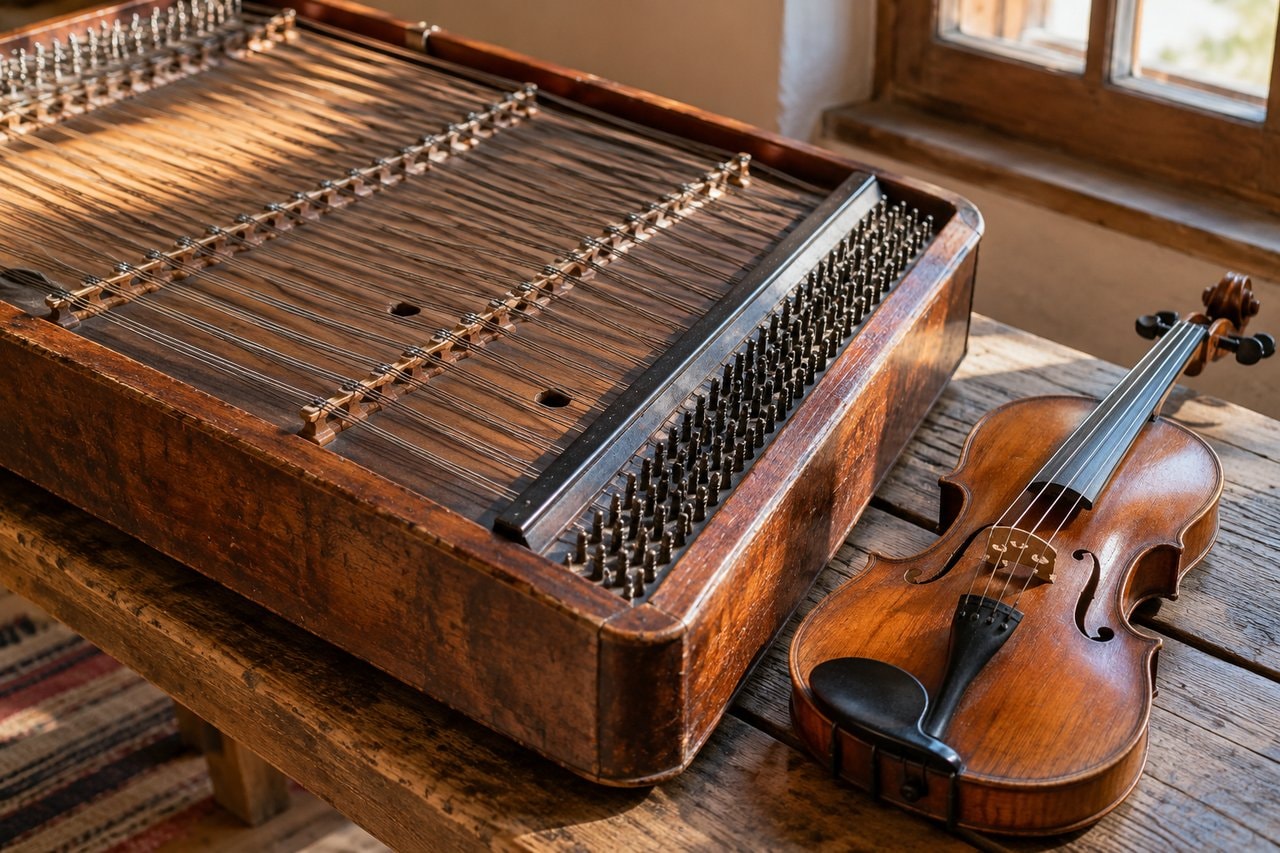
Wikipedia’s article on the lăutari distinguishes the Romanian occupational word for a musician from the Romani musical clan associated with it. Lăutari commonly play in groups called taraf. The source describes their music as varied by region, technically demanding and rich in ornament, with improvisation an important part of performance.
This is a history of skilled work as well as a history of repertory. The article identifies Roma musicians as central to the tradition while also recording Romanian, Jewish and Turkish musicians. Its account includes the earlier enslavement of Roma musicians. A respectful description can hold those facts together without reducing a musician’s art to an ethnic label or treating inequality as a picturesque background. The guide to the peoples of the region gives fuller context for that history.
The hora and collective movement
The Wikipedia article on the hora describes a circle dance shared across southeastern Europe, including Romania and Moldova. In the Romanian and Moldovan forms, dancers hold hands and move together, accompanied by instruments that may include violin, accordion, cimbalom and wind instruments. The dance is associated with weddings and other celebrations.
The relationship between tune and movement is a useful starting point. A description of the dance can explain its social setting, while a description of the music can examine pulse, repeated phrases and changes in pace. Neither should be assumed to explain every local version. Comparing the terms used in separate accounts helps a reader recognise a shared name without erasing differences between places.
Ciprian Porumbescu
Wikipedia’s biography of Ciprian Porumbescu identifies him as a Romanian composer born in Bucovina whose music ranged across genres, particularly choral writing and operetta. It names Crai nou, Serenada and the ballad for violin among his well-known works. The account connects the melodic appeal of his compositions with inspiration from folklore.
Porumbescu offers a route from a named work to the cultural setting of its making. A reader can begin with the genre, the instruments and the role of song in the composition. The biographical outline then gives those choices a setting in Bucovina and in his musical education. National themes are part of that account, but they should be described through the particular works rather than turned into a claim about all Romanian music.
George Enescu
The Wikipedia biography of George Enescu presents a musician whose work included composition, violin and piano performance, conducting and teaching. His musical studies took him to Vienna and Paris. The article identifies Romanian folk music as an influence on his work and names the Romanian Rhapsodies, the opera Œdipe and his orchestral suites among his best-known compositions.
That range makes it useful to approach Enescu through contrasting kinds of work. An orchestral composition, an opera and chamber music ask different things of performers and listeners. Folk influence is a point of entry, but it does not replace attention to the shape of the composition. The title, the performing forces and the relationship between passages can all be noted before making a broader interpretation.
Dinu Lipatti and the art of interpretation
Wikipedia’s biography of Dinu Lipatti describes a Romanian pianist and composer born in Bucharest who later worked in Geneva. It emphasises the care of his preparation and the esteem in which his surviving recordings are held. His life places the performer alongside the composer in an account of Romanian art music.
A recording makes interpretation available for repeated listening. The listener can return to the handling of a phrase, the clarity of the accompaniment and the relationship between successive passages. Such observations are a firmer basis for discussion than a general label such as brilliant or emotional. They also leave room to distinguish admiration for a performance from a factual account of the musician’s career.
A concert hall in Bucharest
The Wikipedia article on the Romanian Athenaeum identifies it as a domed, circular concert hall in central Bucharest and describes its style as largely neoclassical with romantic touches. It brings architecture into the musical story: performance has a setting, and a hall can become part of a city’s cultural identity.
The guide to university towns places Bucharest within a wider geography of learning. For music, the useful distinction is between the building, the works performed and the people who interpret them. Following each separately gives a reader a clearer account of how a musical tradition lives in places, repertories and skilled performance.