Folklore also needs a clear boundary between description and belief. A story about a supernatural creature belongs to the study of a tradition. Its presence in a reference work does not make the creature real, and a ritual’s symbolic meaning is not a practical claim about what it can accomplish. The pages on music and art and architecture follow related questions about performance, materials and form.
Stories and imagined beings
The Wikipedia overview of Romanian folklore describes a relationship between rural traditional culture and learned culture. Its account includes stories about the making of the world, beliefs about the natural landscape and creatures such as strigoi and moroi. These are presented here as figures within folklore, rather than explanations of the world outside the stories.
The context of a story matters. A reader can ask which version is being described, whether the account concerns a belief or a literary retelling, and how the description distinguishes a creature from a human role. A list of supernatural names alone tells little about storytelling. Comparing the setting and the sequence of a narrative gives a firmer route into the tradition while leaving its supernatural claims within the story.
Miorița and the pastoral ballad
Wikipedia’s article on Miorița describes a pastoral ballad with versions whose content can differ substantially. A speaking ewe warns a shepherd of a plot against him; the shepherd’s response imagines how his death might be described to his mother and to his flock. Nature becomes part of the imagined ceremony. This brief outline identifies the narrative without turning it into an account of real conduct.
The ballad invites questions about voice and transmission. Its speaker’s response belongs to the work, and cannot safely be made into a statement about how all Romanians think. Nor should differences between versions be erased in search of an ideal text. A reader can compare the role of the animal, the message to the mother and the imagery of the natural world, while keeping the sources of each version clear.
The doina and a performer’s phrase
The Wikipedia article on the doina describes a freely shaped, ornamented tune style that allows improvisation within a pattern. It includes sung and instrumental forms. UNESCO’s description of the doina emphasises solo performance, regional variation and a range of themes that includes joy, sadness, solitude and love.
The setting can be ordinary as well as ceremonial: UNESCO describes performance outdoors, at home and at work. That breadth is useful because it keeps the doina from being understood only as a formal stage piece. When listening, the lengthening of a note or a change in ornament can be followed as a performer’s choice. A summary of themes gives context, but the sound remains an important part of the subject.
Căluș and the Călușari
Wikipedia’s article on the Călușari identifies them as participants in a traditional dance called căluș and describes groups travelling through local communities with musicians. The origins of the tradition remain uncertain. A reader should therefore distinguish evidence about a known practice from a proposed explanation of its beginnings.
UNESCO’s account of the Căluș ritual places it in the Olt region of southern Romania and also connects it with Vlach communities in Bulgaria and Serbia. Its description includes games, skits, songs and dances, with stamping, heel-clicking, leaping and leg movements among the dancers’ skills. Knowledge of dance steps and ritual roles passes through teaching within the tradition.
Those details show that a ritual can contain performance, social organisation and symbolic meaning at the same time. An account should keep the observed movements separate from claims made within a belief system. Describing the tradition does not invite a reader to perform a rite or accept its supernatural meanings.
Mărțișor and the beginning of spring
According to the Wikipedia article on Mărțișor, the modern custom involves wearing a red-and-white threaded object from 1 March. It is practised in Romania and Moldova, with related customs elsewhere in southeastern Europe. Materials, ornaments and the ways of wearing the object have varied across places.
UNESCO’s description of the shared spring custom includes Romania, the Republic of Moldova, Bulgaria and North Macedonia. It describes making, giving and wearing the thread, followed by its removal when signs of spring appear. The account stresses informal teaching between generations and the participation of communities in documenting the practice.
The object is small, but the questions it raises are substantial. Who makes it, how is the skill taught and what local explanation accompanies it? A material description of colour and thread should remain separate from a statement of symbolic meaning. Such distinctions allow comparison without claiming that related customs are identical.
The hora as shared movement
Wikipedia’s article on the hora places this circle dance within southeastern Europe and describes its Romanian and Moldovan forms as dancers holding hands and moving together. Instruments accompany the dance, and weddings and celebrations provide important settings. Its name appears in related forms across different languages and places.
The dance belongs to social life as well as to a repertory of steps. A reader can study how participation is described, which instruments accompany the movement and what setting gives it meaning. A shared name should begin a comparison, rather than end it. Local descriptions remain necessary to understand a particular form of the dance.
Skills recognised as intangible heritage
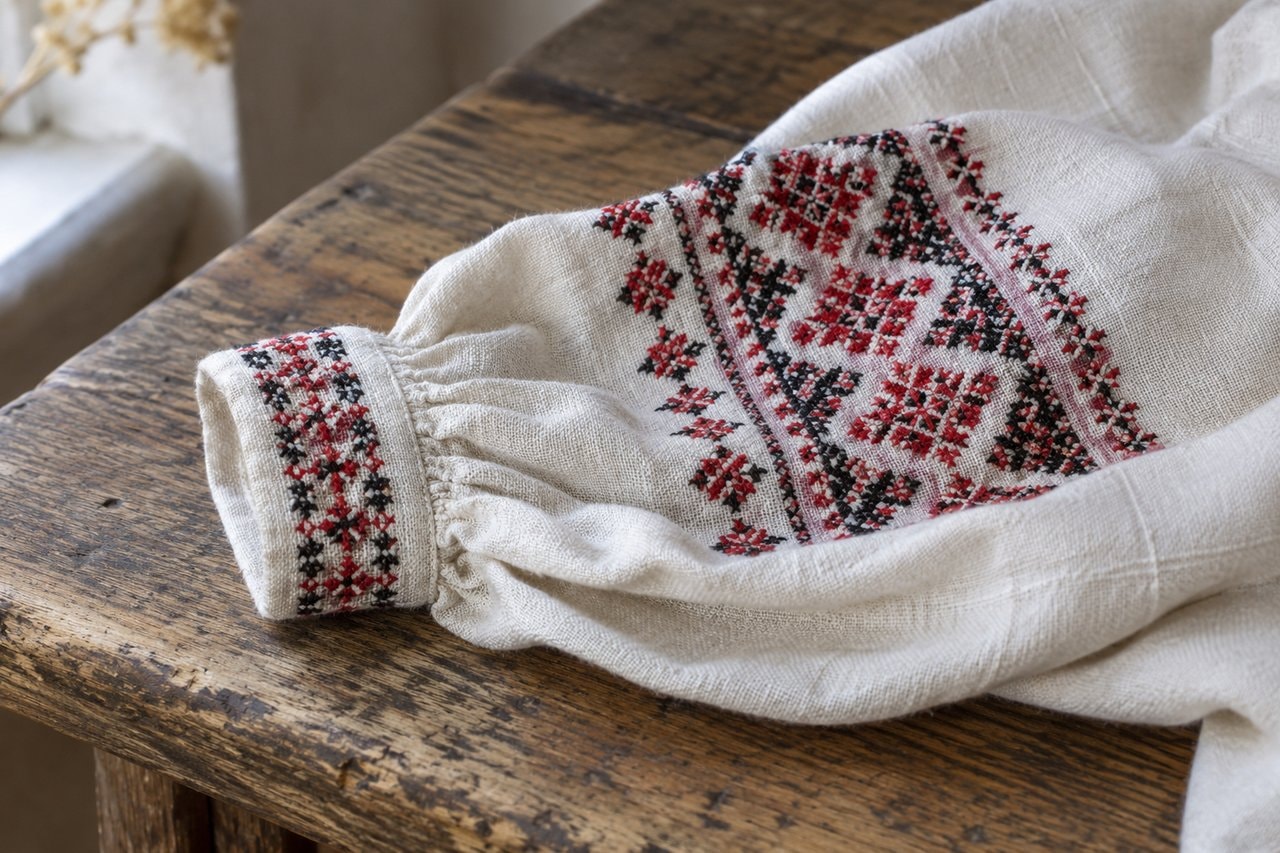
UNESCO’s page on Romania’s intangible heritage lists the doina and the Căluș ritual beside crafts, dance and shared practices. Its entries include blouse embroidery, wall-carpet craftsmanship and Horezu ceramics. The list helps distinguish a building or object from the knowledge and social practice through which people make, use or perform something.
Recognition is an entry point for study, rather than a substitute for description. A reader still needs to know whose practice is being discussed and how it is passed on. The guide to the peoples of the region provides context for discussing communities with care.
Rural buildings in a museum setting
The Wikipedia article on the Village Museum in Bucharest identifies an open-air ethnographic museum that presents traditional rural life through buildings and objects from different Romanian regions. The museum’s own Romanian-language pages also identify its permanent outdoor exhibition and collections. This brings material culture into the discussion beside song, story and dance.
A museum setting lets buildings be compared, but it also changes their context. A farmhouse, church or working structure once belonged to a place and a pattern of use. Reading its regional identification and purpose is therefore part of looking carefully. The building’s construction and the museum’s arrangement are related subjects, and keeping them distinct avoids treating a collection as a complete village life.
For a classroom discussion, a useful note records the name of the tradition, its stated place and the kind of evidence being used. A description of performance, a narrative summary and a description of an object should remain separate. That care makes comparison possible without requiring every song, story and craft to carry the same cultural meaning.